In my last article, I discussed the importance of proper titles in regards to qualified accounts,...


At Virtus Wealth Management, your Southlake independent financial advisors, we help our clients prepare for a financially-secure future by developing long-term strategies that focus on the “big picture” versus short-term gain, thereby managing risk.
Today’s economic conditions and uncertain financial markets require the savvy investor to go beyond traditional boundaries.
Our mission is to provide innovative, sophisticated and highly customized wealth management solutions and financial advice that address all facets of your finances.
We tailor everything to each of our clients’ specific needs so that each client can pursue his or her different goals.
Virtus Wealth Management is the product of a 2016 merger between two well-established Texas wealth management firms.
Wealth management is more than just investment advice – it includes all aspects of a client’s financial life.
In my last article, I discussed the importance of proper titles in regards to qualified accounts,...

I cannot stress the importance of you passing this article and the second in the series on to your...
Wealth management is more than just investment advice – it includes all aspects of a client’s financial life.
At Virtus Wealth Management, we believe we can help you no matter what age you are, what life stage you are in, or how much money you are working with. We want you to feel educated, empowered, and involved in the planning of your financial future.
The market has been hit over the past week due to the U.S. and Iran conflict. The question is if this is a time to worry about a longer-term and steeper hit to the markets.
The first thing I would like to point out is that regional wars rarely have a long-term impact on the stock market. The market sure did well during the Russia and Ukraine war. In fact, here is a chart of the 1 month, 3 month and 1 year returns after the start of each of the recent conflicts started (source S&P 500 and Financial Synergies):
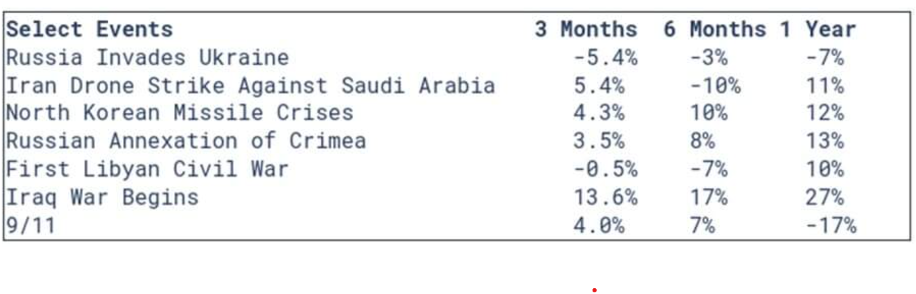
As you can see, there are only two instances where the S&P 500 was negative a year after the conflict started. However, in the Russia/Ukraine conflict, the market was already battling inflation and the fed raising rates. The S&P 500 was down 7% in January of 2022 due to inflationary concerns, in February Russia attacked, and from there the market was down another 7% over the next 12 months. Did the conflict or inflation cause the drop? That answer is easy for me because the S&P 500 had a great 2023 when the fed announced they did not plan on raising rates anymore while the war is still going on.
In our current case, the market has reacted poorly to the news primarily due to the shock higher oil prices will have on companies’ earnings. Typically, these regional wars do not lead to long-term oil production disruptions. We also need to recognize there are major differences between now and wars like these decades ago. The major one is the U.S. is now the top oil producer in the world. The world is less reliant on Iranian oil.
Finally, I have often mentioned watch the bond market. The bond market, while not perfect, is a predictor of what really concerns the institutional investors. To cut to the chase here, the bond market spreads between short-term and longer-term rates do not indicate that the bond investors are worried about a recession or slowdown in growth but instead that the sticky inflation is now even a greater risk due to higher energy prices. The Federal Reserve has been mixed on whether to cut, do nothing, or raise rates. Will this pressure the fed to now raise rates?
The answer on rate movements by the Federal Reserve will probably depend on the length of this conflict. At this point, the best path is to stay the course until we get more information on inflation. I will state that I do have a concern about the employment market longer-term and I am watching closely but for the sake of being succinct, I will address that in a future article.
To summarize, as long as the war stays regional and doesn’t last years, I don’t expect it to have a drastic impact on the stock market.
Content in this material is for general information only and not intended to provide specific advice or recommendations for any individual. All performance referenced is historical and is no guarantee of future results. All indices are unmanaged and may not be invested into directly.
The economic forecasts set forth in this material may not develop as predicted and there can be no guarantee that strategies promoted will be successful.