Who Can Open a Trump Account? A Trump Account (a Section 530A custodial IRA-style account for a...


At Virtus Wealth Management, your Southlake independent financial advisors, we help our clients prepare for a financially-secure future by developing long-term strategies that focus on the “big picture” versus short-term gain, thereby managing risk.
Today’s economic conditions and uncertain financial markets require the savvy investor to go beyond traditional boundaries.
Our mission is to provide innovative, sophisticated and highly customized wealth management solutions and financial advice that address all facets of your finances.
We tailor everything to each of our clients’ specific needs so that each client can pursue his or her different goals.
Virtus Wealth Management is the product of a 2016 merger between two well-established Texas wealth management firms.
Wealth management is more than just investment advice – it includes all aspects of a client’s financial life.
Who Can Open a Trump Account? A Trump Account (a Section 530A custodial IRA-style account for a...

Trump Account Information A child’s investment account that functions like a traditional IRA at...
Wealth management is more than just investment advice – it includes all aspects of a client’s financial life.
At Virtus Wealth Management, we believe we can help you no matter what age you are, what life stage you are in, or how much money you are working with. We want you to feel educated, empowered, and involved in the planning of your financial future.
Estate planning is the process of organizing how your assets will be managed and distributed after your death or if you become incapacitated. It typically involves creating legal documents such as wills, trusts, powers of attorney, and healthcare directives. An effective estate plan ensures that your wishes are honored, your loved ones are cared for, and your financial legacy is preserved.
Estate planning isn’t just for the wealthy—it’s essential for anyone who wants to protect their family and property, avoid probate, and minimize estate taxes or legal disputes.
Estate planning is crucial because it gives you control over who inherits your assets and how. Without a plan in place, state laws will determine how your property is distributed, which may not reflect your wishes. A comprehensive estate plan also allows you to:
Ultimately, estate planning brings peace of mind, knowing your loved ones are protected and your legacy is secure.
The one area of wealth management that people ignore the most is estate planning. Per The American Association of Retired Persons (AARP), 60% of Americans lack an estate plan. And 40% of those between 50-70 lack an estate plan.
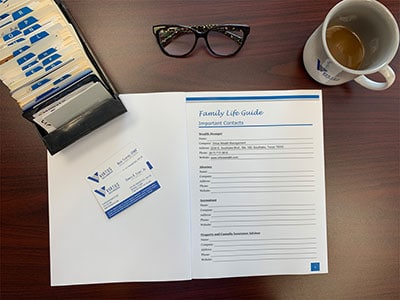
We are here to let you know it is really an easy process which shouldn’t be procrastinated. By clicking here you can find an easy simple checklist of the items you should consider when putting an estate plan together. We also offer our Family Life Guide, this guide is a worksheet we designed to help you gather and organize all of your financial, legal, and medical affairs. It can be used as an estate planning tool to help your loved ones as well as a strategy to consolidate and simplify important information for your own everyday use.
Below I discuss strategies you can use to help your estate prior to death. First let’s discuss the basics of estate planning.
The first rule of estate planning is the K.I.S.S. philosophy. Keep it simple unless you consider the consequences of a complicated estate plan and then decide to move forward. A complicated estate plan can become a nightmare for your loved ones after you pass away, as well as cost you significant money, not only upfront but on an ongoing basis due ongoing maintenance.
Before moving forward with an estate plan, knowing the laws of your state in regards to marital property is important. There are three main types:
You now know the marital property law of your state and want to move forward. The next step is understanding the difference between a will or a trust. There is one huge difference. A will typically dies with you at your death while a trust lives on. More specifically, in a will once you die and the money transfers to your beneficiary, you no longer have any control of what happens to that money. With a trust you can dictate how that money is disbursed long after your death.
A solid estate plan typically includes several essential legal documents that work together to protect your interests and your loved ones:
A will is the simplest and easiest way to plan your estate. A will is either a document or video, which has been witnessed, in which you direct who receives your property after you die, as well as identifies who you assign control over your life if you can no longer make decisions while living. There are 4 major parts of an estate plan in a will.
The benefits of a will are the simplicity of the estate plan and the cost. The negative is that they are not very efficient in complicated estate planning.
It is important to note there are many different types of trusts. We are going to discuss in more general terms. If you want more information about specific types of trusts, please contact us to discuss.
A trust is a legal document which a third party, the trustee, is given the right to manage your assets as per your directives stated in the trust document. You can be living or deceased when you assign this right to the trust.
Even though there are many types of trust, they fall into one of two categories:
There are several benefits to a trust, including that irrevocable trusts typically protect your assets from creditors. If a beneficiary is at risk of being pursued by creditors, a trust may be effective in protecting those assets.
Trusts also provide control to you in cases in which you worry about a beneficiary receiving too much money at once. For example, a child that might have an addiction problem or very bad with money. You can establish a trust so that they don’t receive all the money at once.
A trust is typically needed for special needs beneficiaries. There are specific trusts for these situations.
Trusts are sometimes used to ensure money stays in the blood-line versus going to a son or daughter in law. Keep in mind, as we discussed earlier, this also can be accomplished much cheaper using separate property accounts. Ensuring your beneficiaries are educated on your wishes and their options might be a much cheaper way to proceed then a trust.
Trusts typically avoid probate. This is my least favorite reason to set up a trust. In many cases the trust will end up costing much more than the probate. For example, in Texas the court cost is approximately $350. You should be able to find an attorney, if an executor chooses not to probate the will themselves, for approximately $1,000. If you manage your trust correctly and have it reviewed at least every 3 years, you will spend much more on the trust than probating a will. This depends on the cost of probating in the state you reside in. We recommend you understand that cost before establishing a trust for the sole purpose of passing probate.
Finally, a trust may reduce, or eliminate, your estate tax liability. This benefit has been reduced significantly with the current estate tax exclusion. However, the exclusion limits do change and have varied significantly – ranging between $1 million and $12 million just since the turn of the century. When estate planning, it is important to know what the limit is and how it will impact your situation.
A power of attorney (POA) is a legal document that authorizes someone you trust to make financial or legal decisions on your behalf if you’re unable to do so. There are different types of POAs, including:
Choosing the right POA and the right person for the role is a vital part of any estate plan.
A living will, also known as an advance directive, outlines your preferences for medical care if you are unable to communicate those decisions yourself. This document can cover:
Advance directives help your loved ones avoid difficult decisions during emotional times and ensure your medical care aligns with your values.
We offer one warning, a trust is a commitment. If one goes down this path, know it isn’t a one-time thing. We can say the same about a will, which is true but an “I love you will,” which fits many Americans, is less of a commitment than a trust. An “I love you will” is the typical will in which each spouse is the primary beneficiary of the estate and then after the second to die, the children receive the estate.
At Virtus Wealth Management, we believe it is our job to fully explain your options so you can make an educated decision on which is best for you.
As in most cases involving your estate plan, if something seems overly complicated, a second opinion is wise. Typically, estate planning does involve consulting with a few professionals including a lawyer and financial advisor, among others. While your financial advisor may not be trained in estate law, we have years of experience reviewing and implementing estate plans. Thus, we can provide you with guidance on when you might need to seek the opinion of a second lawyer or when you might need to simplify your plan in general. If you have questions regarding your estate plan or where specifically you should start, give our office a call to schedule a complimentary consultation with one of our advisors today.
_____________________________________________________________________________________
This information is not intended to be a substitute for individualized legal advice. Please consult your legal advisor regarding your specific situation. Virtus Wealth Management and LPL Financial do not provide legal advice or services.
Estate planning is influenced by state-specific laws, which can affect everything from how property is titled to how it’s transferred after death. For example, community property states differ significantly from common law states. Additionally, each state has its own rules for probate, inheritance taxes, and spousal rights.
That’s why it’s essential to work with professionals who understand the laws in your state and can tailor your estate plan accordingly to avoid unintended legal or tax consequences.
Even the most well-intentioned plans can fall short if not properly executed. Common estate planning mistakes include:
Avoiding these errors can save your family significant stress and expense down the line.
At Virtus Wealth, we offer personalized estate planning services designed to simplify the process and protect what matters most. Our experienced advisors work closely with you to:
Whether you need to draft a will, set up a trust, or plan for incapacity, Virtus Wealth provides clarity, compassion, and expert guidance every step of the way.
Want to ensure your assets are handled exactly how you intend? Contact our team for a free estate planning consultation today.